Department of Biological Sciences
 

Dana M. Hawley

You are here: Home > People > Faculty > Dana Hawley

Hawley

Education:

  • 2005 – present Molecular Evolution Postdoctoral Fellow, Smithsonian Institution
  • Ph.D. 2005 Cornell University (Ecology and Evolutionary Biology)
  • B.S. 1999 College of William and Mary (Biology)

Courses Taught:

Selected Publications

Hawley, D.M.  2007.  Population bottlenecks:  the importance of looking beyond genetics. Animal Conservation 10, 17-18.

Hawley, D.M., Jennelle C.S., Sydenstricker, K.V., and Dhondt, A.A.  2007.  Pathogen resistance and immunocompetence covary with social status in house finches.  Functional Ecology 21, 520-527.

Hawley, D.M., Davis, A.K., and Dhondt, A.A.  2007.  Transmission-relevant behaviours shift with pathogen infection in wild house finches (Carpodacus mexicanus).  Canadian Journal of Zoology 85: 752-757.

Dhondt, A.A., Sydenstricker, K.S., Hawley, D.M., and Jennelle, C.J.  2007.  Experimental evidence for fomite transmission of Mycoplasma gallisepticum in house finches.  Avian Pathology 36, 205-208.

Hawley, D.M.  2006.  Asymmetric effects of experimental manipulations of social status on individual immune response.  Animal Behaviour 71, 1431-1438.

Hawley, D.M., Hanley, D., Dhondt, A.A., and Lovette, I.J.  2006.  Molecular evidence for a founder effect in invasive house finch (Carpodacus mexicanus) populations experiencing an emergent disease epidemic.  Molecular Ecology 15, 263-275.

Hawley, D.M., Lindstrom, K.M., and Wikelski, M.  2006.  Experimentally elevated social competition compromises humoral immunocompetence in house finches.  Hormones and Behavior 49, 417-414.

Dhondt A.A., Badyaev A., Dobson A.P., Hawley D.M., Hochachka W.M., and Driscoll M.J. 2006.  Mycoplasmal conjunctivitis spreads more slowly in native than in introduced range of the host. Ecohealth 3, 95-102.

Hawley, D.M., Sydenstricker, K.V., Kollias, G.V., and Dhondt, A.A. 2005.Genetic diversity predicts pathogen resistance and cell-mediated immunocompetence in house finches.  Biology Letters 1, 326-329.

Lindstrom, K.M., Hawley, D.M., Davis, A.K. and Wikelski, M.  2005. Stress responses and disease in three wintering house finch (Carpodacus mexicanus) populations along a latitudinal gradient.  General and Comparative Endocrinology 143, 231-239.

Assistant Professor
E-mail: hawleyd@vt.edu
Telephone: (540) 231-8946

Research Focus:

My research program investigates the ecological and evolutionary mechanisms that underlie pathogen susceptibility within and across ecological scales, from single host individuals up to multi-host communities. I currently study disease dynamics in the context of two broad frameworks: 1) genetic and species-level diversity, and 2) environmental and social stressors. I approach disease ecology from a multi-disciplinary perspective in order to understand how individual physiology, population genetic structure, social behavior, community composition, and environmental context all interact to influence host disease response. My current research projects are briefly described below:

  1. Social behavior and disease. Social behavior in animals influences many components of individual physiology, including resistance to pathogens. My research examines how variation in foraging and flocking behavior in a common social backyard bird, the house finch (Carpodacus mexicanus), influences an individual’s chance of 1) becoming infected with a common bacterial pathogen and 2) recovering once infected. This line of work merges individual and population scales by viewing social behavior as a crucial link between population phenomena such as density and individual-level physiology and fitness in the presence of selection pressures such as pathogens.
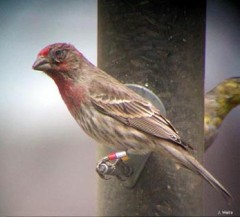
  2. Community and landscape approaches to disease ecology. As part of an NSF-funded collaborative research project, we are testing how avian community composition and landscape urbanization influence disease dynamics in multiple avian hosts of a recently emerged bacterial pathogen that causes debilitating conjunctivitis in its hosts (see picture below). The theoretical backbone of this project is a mathematical disease model, but I will be estimating realistic empirical parameters using field and laboratory experiments. This line of research will help to reveal the potential for human-induced changes in animal communities and landscapes to magnify susceptibility to disease outbreaks.
  3. Genetic diversity and disease susceptibility. My research to date demonstrated that historical reductions in genetic diversity within an introduced species can compromise host resistance and immune response to a recently emerged pathogen. This line of work will be expanded to multiple hosts and pathogen systems in order to understand the generality of this effect, the mechanisms underlying it, and the ecological scales at which diversity can influence host disease response.
  4. Aquatic Toxicology and Disease Susceptibility. Environmental pollutants are well known for their observable harmful effects on natural populations of vertebrates, but the subtle physiological impacts of environmental contamination are often overlooked. I recently joined a collaborative research team that studies the South River basin in VA, which contains unusually high levels of mercury contamination. I’m examining whether mercury contamination influences the health of a diverse avian breeding community across a gradient of polluted and clean rivers.
 

Note to Prospective Students:

My research integrates diverse subdisciplines including disease ecology, behavioral ecology, molecular evolution, population and community ecology, and immunology. I hope to attract students who have equally broad interests, the persistence to bridge disparate fields, and a strong foundation in the theory and practice of ecology and evolutionary biology. If you are interested in joining my lab, please email me a summary of your general research interests and a copy of your CV.

Picture 1: A male house finch with visible eye symptoms of Mycopasma gallisepticum infection.

photo

Picture 2: Catching breeding tree swallows in southern VA in order to measure their immune response along polluted and unpolluted rivers.

photo